
The Long Game


Near the end of a two-hour call, I said something to Meredith Boyd that I hadn’t planned on saying out loud: that UNIFI might be the company I’ve encountered in this recycling space with the least marketing and the most substance behind it. It wasn’t a compliment I’d prepared in advance. It was an observation that had been quietly accumulating for two hours, and the moment I said it, I realized it was the actual question this piece needed to answer, not a closing pleasantry. Why does the company holding the most evidence get the least benefit of the doubt, while the companies holding the least evidence get treated as though they’ve already proven something?
Boyd leads innovation, marketing and brand sales at UNIFI, and somewhere underneath that title is a trained chemist, which matters more than it sounds like it should. As a chemist, she told me at one point, almost as an aside, you question everything, you want data to the nth degree before you commit to a claim. That instinct runs through everything she said on the call, including, pointedly, her own company’s claims. It’s an unusual posture for someone whose job nominally involves selling a sustainability story, and it’s the reason the rest of this piece is worth taking seriously rather than filing under brand profile.
Before REPREVE had a name, before a single plastic bottle entered the supply chain, UNIFI asked itself a question that had nothing to do with marketing. What could UNIFI do better? The answer, when it arrived, wasn’t a campaign. It was an inventory. The company looked inward at its own production floors and found yarn waste sitting in plain sight, the kind of operational byproduct most manufacturers write off as a cost of production rather than treat as a resource. That is the actual origin of what would become the world’s most recognized recycled fiber brand. Not a beach cleanup, not a bottle. A company auditing its own waste stream years before it ever tried to sell anyone on a story about it.
That origin matters because of what happened next, which almost nobody outside the company has had explained to them properly. REPREVE launched commercially in 2007 out of Yadkinville, North Carolina, running majority yarn waste with a minority of post-consumer bottles folded in. That ratio flipped within a few years, not because bottles made a better yarn, but because the infrastructure to collect them already existed. Sortation, baling, redistribution: all of it had been built for an entirely different reason, recycling for its own sake, years before UNIFI ever needed it. Bottle-derived REPREVE scaled on the back of somebody else’s plumbing. Textile waste had no plumbing at all, and still mostly doesn’t.
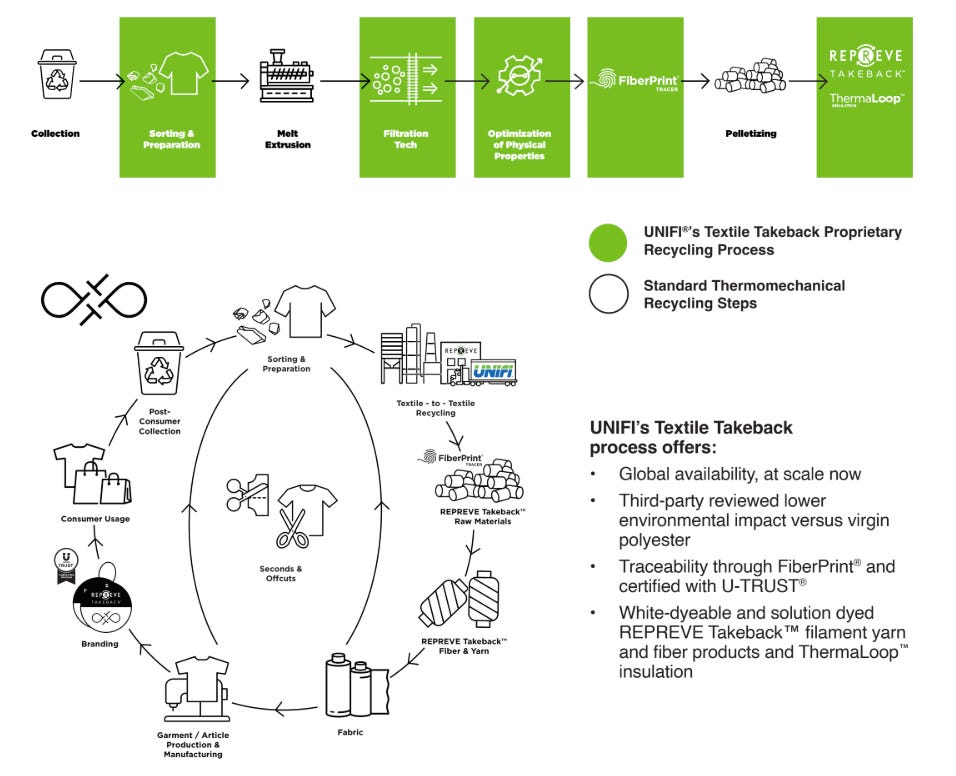
That gap is the real content behind the decade Boyd describes between UNIFI’s first internal conversations about textile-to-textile recycling and REPREVE Takeback’s recent full, hundred-percent fabric-waste launch. It wasn’t ten years of hesitation. It was ten years spent building the parts of a recycling system that nobody photographs for a sustainability report. Fabric waste arrives chemically dirtier than a bottle does, carrying dyestuff, print pastes, and topical finishing chemicals that have to be filtered out or compensated for before the resulting resin can be spun into a filament yarn destined for an automotive interior or a piece of technical apparel, categories with essentially zero tolerance for inconsistency. UNIFI calls the resulting system Textile Takeback, an augmented thermomechanical process built around proprietary filtration and material handling modules developed specifically to manage that contamination.
The detail Boyd kept returning to was material handling. Waste, she said, is dynamic. It doesn’t arrive in the same consistent lots that virgin monomer does. And the entire commercial proposition of REPREVE has always rested on convincing a mill that a recycled yarn will behave exactly like a virgin one, batch after batch, with no lot changes for the mill to plan around and no color drift to chase down on the floor. That consistency isn’t a side effect of scale. It is the actual product UNIFI sells. It is also the single hardest thing to manufacture, which is the entire reason it took ten years rather than two.
Today the company still sources predominantly post-industrial fabric waste, offcuts and misprints and seconds, for REPREVE Takeback and its ThermaLoop insulation line, rather than post-consumer garments. The reasoning is structural rather than aspirational. There’s a secured, traceable route to recover post-industrial waste because it originates inside facilities UNIFI already has relationships with. Post-consumer collection still runs largely on campaign and capsule programs, in Europe as much as anywhere else, because true sorting and redistribution infrastructure at scale hasn’t been built yet, anywhere. Rather than wait for that infrastructure to mature before doing anything, the posture is to do the best available now with feedstock that has a verifiable pathway, and let post-consumer volume be absorbed into the platform as the collection systems around it catch up. It’s a narrow distinction with large consequences, because it means REPREVE Takeback’s hundred-percent recycled claim is currently underwritten by waste streams the company can trace end to end, not by an aspiration about what post-consumer collection will eventually look like.
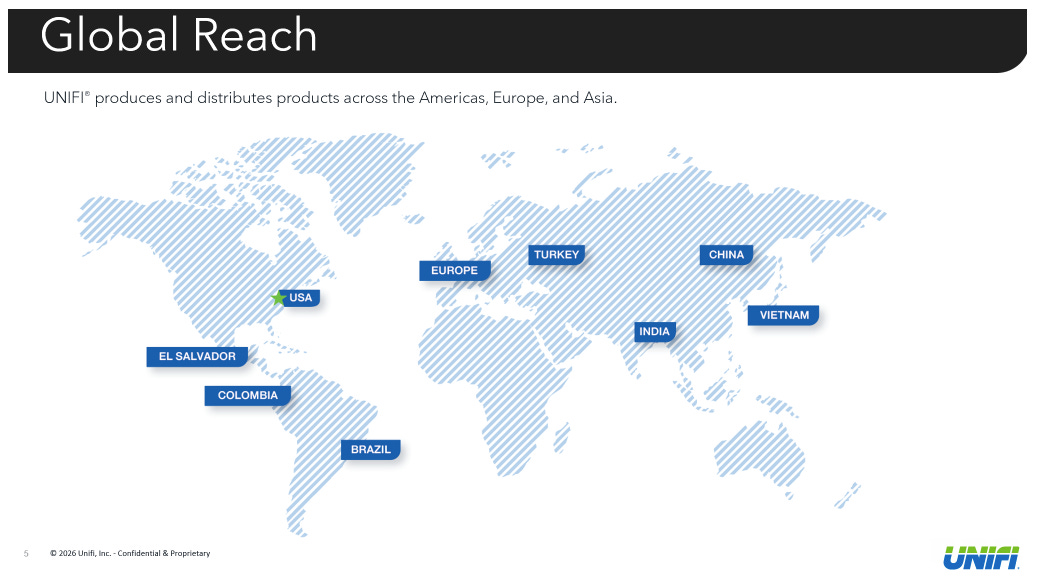
None of this happened in North Carolina alone. More than a decade ago, UNIFI decided to establish a manufacturing presence in Asia, specifically because the overwhelming majority of the world’s textiles are made there, and a claim like REPREVE’s has to be built close to where the fabric actually gets produced rather than shipped in as a marketing assertion from across an ocean. The entity, Unifi Textile (Suzhou) Co. Ltd. in Suzhou, sits close enough to Shanghai to serve mills and brand sourcing offices across the region while exporting into Europe and Southeast Asia, alongside separate operations in India and Turkey. What’s more telling than where UNIFI went is what it deliberately chose not to do once it got there. It does not compete on commodity production in Asia. Trying to match the largest commodity polyester producers on price would have meant chasing scale and capital intensity for its own sake. UNIFI saw more value in building where it could differentiate. Asia production is reserved entirely for value-added, traceable, REPREVE-branded product, the one category where two decades of accumulated credibility actually converts into commercial defensibility instead of getting flattened in a race to the bottom on cost per kilogram. The Textile Takeback process now runs out of two hubs, China and North Carolina, deliberately stratified across hemispheres so a brand sourcing from either region gets the same product, the same variants, the same quality, rather than a regional compromise dressed up as global consistency.
I asked Boyd, somewhere past the hour mark, whether any of this kept her up at night. Whether the noise around hyperscale and gigascale and the next wave of well-funded chemical recyclers made her anxious about UNIFI’s position. Her answer was almost unsettling in how calm it was. I don’t have to go to sleep every night wondering if we can be successful at what we set out to do, she said. Do I wonder, will we be able to deliver to our shareholders and the market what we promised? No. I can go to sleep very soundly, because I know we’ve already done it. Sit with that sentence for a moment, because it’s doing more work than it looks like. It isn’t bravado. It’s the difference between a company that has to convince an investor it will eventually be able to do something, and a company whose only job left is to keep doing the thing it has already demonstrably done, at scale, for two decades. That sentence is the closest thing this conversation produced to a thesis statement, and it’s also exactly the kind of confidence the rest of the industry has somehow learned to treat as a red flag rather than a credential.
Because here is where the asymmetry I started with stops being an abstraction. I’ve reviewed a meaningful share of the lifecycle assessments circulating among the current generation of next-gen recyclers, the chemical recycling and fiber-to-fiber startups raising the kind of capital that gets covered as an inevitability rather than as a bet. Not all of them look promising. A number carry an environmental footprint two to three times heavier than what UNIFI already delivers commercially today, and yet they absorb a fraction of the scrutiny, because they sit under a label, next-gen, that functions less like a description and more like an exemption from comparison. I put that observation to Boyd directly. Her answer was the most precise articulation I’ve heard anywhere of how incumbency actually gets penalized in this industry. A brand-new, single-product startup has no history to be measured against. Nobody has met them before, so there’s no comparison available except the one the startup chooses to offer about itself. A company at UNIFI’s scale, by contrast, gets evaluated against everything it has already done, every prior product, every prior claim, every commitment that may or may not have fully landed. Apples and oranges, she called it, almost generously, recognising that the comparison was never a fair one. But the structural point holds regardless of how kindly she framed it. A track record is supposed to function as an asset. In this industry, it frequently functions as a liability, because it’s the only thing available to interrogate, while the unproven alternative gets graded purely on the story it tells about itself.
This is the same asymmetry I’ve written about before in the context of natural versus synthetic fiber scrutiny, the established target absorbing disproportionate attention precisely because it’s established enough to have generated data worth interrogating, while a newer category escapes comparable interrogation simply by not yet having produced enough data to interrogate. What’s striking is watching that exact mechanism replay itself inside a single material category, recycled polyester, splitting an incumbent thermomechanical platform from an emerging chemical recycling cohort along an almost identical fault line. And there’s a technical data point underneath the asymmetry worth sitting with. UNIFI’s internal data, drawing on NREL and Royal Society of Chemistry research, puts thermomechanical recycling at roughly 1.8 kilowatt-hours of energy per kilogram of output against an average of 12.3 kilowatt-hours per kilogram across the chemical recycling technologies it benchmarked, with lower water use and a lower waste factor across the board. That comparison carries the obvious caveat that any vendor-produced figure does: it’s directional rather than independently audited against UNIFI’s specific lines, and the diversity of chemical recycling processes means no single average can fairly represent the category. But directionally it tracks with the underlying chemistry. Thermomechanical recycling skips the energy-intensive step of breaking a polymer all the way back down to monomer and rebuilding it from scratch, which is exactly why it’s cheaper to capitalize and faster to scale. It also explains why Boyd regards the industry’s current fixation on chemical recycling with less the instinct of an incumbent protecting its turf and more the genuine bewilderment of a chemist. Her read on why so much capital and attention has chased chemical recycling instead is that it’s solving a more glamorous problem, the messy diversity of post-consumer waste streams, rather than starting from the more boring question of which available pathway delivers the lowest environmental impact today. Chemical recycling will be necessary for feedstocks that thermomechanical processes genuinely cannot touch, she was careful to say, and she wants those technologies to succeed. But necessity for a subset of feedstock is a different claim than superiority as a category, and most of the coverage this space gets doesn’t bother making that distinction.
I asked her directly whether UNIFI would ever venture into chemical recycling itself, given the company clearly has the engineering bench to attempt it, or whether it might instead partner with one of the existing chemical recyclers rather than build the technology from scratch. UNIFI will pursue any technology that delivers on a genuine feedstock or property need, she said, and values collaboration at every point of the chain without question, but it looks for partners where the technical and economic viability is something the company can actually have confidence in. Technical viability, she added, even at meaningful scale, is the easy part to confirm. It’s economic viability where things go gray, and that question, in her account, is often met with something closer to silence than an answer. She didn’t name names. She didn’t need to. There’s a lot on the cusp right now, she said, and not a lot that’s proven, and UNIFI is, by her own description, still waiting for some of that proof before it commits capital or its own brand credibility to a partner.
That same caution about what counts as proof versus what counts as promotion runs straight through how Boyd talks about off-take agreements, the headline-grabbing supply commitments brands love announcing alongside a recycling startup. There’s an element of PR in an off-take, she said, as opposed to tangible accountability. A ten-year commitment contingent on a list of conditions being met, which I half-joked would run out of letters of the alphabet before it ran out of conditions, is a fundamentally different thing from a purchase order placed today, and yet press coverage treats the two almost identically. Her counsel to brands, repeated more than once across the conversation, was almost defiantly unglamorous. Put in the purchase order. Not a commitment to convert an entire product line overnight, which she explicitly distinguished as exactly the kind of overcorrection that creates its own risk, but a real, modest, repeatable order sized to whatever a given program actually needs, followed by a second order once the first one proves itself on the floor. That, in her account, is precisely how REPREVE scaled two decades ago, an exponential curve built out of compounding small steps rather than a single triumphant leap. A capsule collection that earns nice press coverage and then quietly disappears is closer to performance than to progress, in her framing, because it never has to survive the unglamorous second and third orders that would actually prove the material holds up inside a real production system running at real volume.
That distinction connects directly to the wave of large-scale bankruptcies that has hit next-generation materials and recycling ventures over the last two years, the kind of collapse that costs more than capital, because it also erases years of engineer and technician hours that never reappear on anyone’s balance sheet. Boyd’s framing of disciplined scaling versus what the industry now reflexively calls hyperscale or gigascale wasn’t abstract caution. It was rooted in something specific she’s watched happen inside fabric mills, repeatedly, for almost twenty years. Any new material that requires even a small adjustment, an extra lab dip because the shade is slightly off, an extra SKU a mill now has to track alongside its existing one, generates real pushback in a supply chain that survives on consistency and treats time as a direct cost rather than an abstraction. Well-intentioned startups, in her account, frequently arrive with technically sound IP and a techno-economic model validated at small scale, only to discover that the assumptions underneath that model, including feedstock cost, processing requirements, and achievable price point, require real revision once the same process gets pushed toward the volumes a brand-scale commitment actually demands. That revision is normal, she stressed, not a sign of failure. But it’s also precisely the gap where the most aggressive capital deployment and the most fragile economics tend to collide, and where a fundraising narrative built around the word hyperscale starts diverging from what a mill floor can actually absorb without breaking something.
What gets lost in most accounts of how recycled materials actually move from a lab to a brand’s product line is that the adoption mechanism itself isn’t a straight line from supplier to brand. UNIFI structures its commercial organization around two separate teams working in opposite directions at once, a direct sales team that works with mills, weavers, and knitters, and a brand sales team that works with retailers and apparel brands directly. It’s a push-pull approach, Boyd said, and if you drew it as a flow chart, there’d be a bunch of two-headed arrows, because the relationship doesn’t run in only one direction. Mills sometimes tell UNIFI exactly what a specific brand is asking for before the brand has said a word to UNIFI directly, which makes the whole organization more efficient. Brands, in turn, sometimes tell UNIFI they want something they haven’t yet seen from their own key mills, and go push those mills to start the conversation themselves. You have to work with both, she said, you cannot just choose one. It’s a small operational detail, but it quietly undercuts a comfortable industry assumption that adoption is something brands hand down to suppliers. In UNIFI’s experience, the credible signal moves in both directions simultaneously, and the company that only optimizes for one side of that arrow is the company that ends up dependent on a single, fickle point of failure.
That commercial architecture also helps explain something the industry rarely credits as a strategic decision rather than an accident of history: UNIFI’s customer mix extends well beyond the apparel industry. The company supplies into automotive, contract and home upholstery, and industrial applications, and that breadth carries consequences the sustainability conversation almost never picks up on. Apparel brands have a well-documented appetite for revisiting material commitments the moment a newer, cheaper, or more narratively exciting option appears. I put that point to Boyd directly, that a competitor offering ten cents per kilogram less in two years would likely pull those brands away regardless of what an off-take agreement said, and she didn’t push back on the premise. A recycler whose entire demand base sits inside one industry and one kind of customer is a recycler one sourcing decision away from a demand collapse. Many of UNIFI’s customers are operating on procurement cycles and product lifespans that look nothing like those of the apparel industry. That diversity isn’t just a market expansion story. It gives UNIFI a demand base that can outlast the volatility of any single sector’s enthusiasm for the category.
The traceability conversation is where the stakes of all of this stopped being theoretical. I’d been hearing, with increasing frequency, a pitch from European-based chemical recyclers positioning themselves on traceability, the claim, roughly, that European-produced recycled content is inherently more verifiable than material coming out of Asia. I put that claim to Boyd directly, partly because UNIFI runs significant production in China and would have every incentive to dismiss it defensively. Her response was more interesting than a defense. She pointed out, almost as an aside, that there’s so little polyester production left in Europe at this point that traceability there is close to trivially easy, simply because the pool of producers has shrunk to a handful. The more substantive traceability risk she described actually sits closer to her own backyard, in the United States, where imported raw material has at points been mislabeled to claim preferential treatment under free trade terms, whether with Central America or under USMCA, that it didn’t legitimately qualify for. Her conclusion was one of the clearest insights from the conversation: traceability isn’t a geography problem. It’s a willingness problem. UNIFI’s FiberPrint tracer, embedded in REPREVE fiber since the platform’s earliest days and verified through its U-TRUST certification system, works identically regardless of which hemisphere the yarn came from, because the tracer travels with the material itself rather than depending on the home address of the facility that made it.
She made the stakes of getting this wrong unmistakably clear without my having to push her toward it. When a brand chases a claim to the ends of the earth and discovers the material behind it isn’t in as robust a situation as advertised, the damage that does to the brand can be devastating, and can take decades to recover from, if it ever does. That’s not a hypothetical risk hovering somewhere out in the supply chain. It’s the actual cost a brand absorbs when it builds a public claim on top of a Tier 3 or Tier 4 supplier it never fully verified, and it’s the entire reason Boyd believes a credible raw material supplier, not a brand and not a finished-goods manufacturer, is the party best positioned to actually carry that risk. It’s also, notably, the same argument she made about regulation. She watches the European Union’s evolving rules around extended producer responsibility and California’s state-level legislation the way most operators in this space do, carefully, but her stated hope wasn’t that legislation would force the industry’s hand. It was that companies make the right decision independently of being taxed or punished into it. That’s a more demanding standard than most public commitments in this industry are built to survive, and it’s consistent with everything else she said across two hours. Compliance is the floor. It was never supposed to be the ceiling.
Which brings me back to the sentence I said to her without planning to, the one about the least marketing and the most substance. I’ve spent enough time around recycled material claims to be reflexively skeptical of almost all of them: the LCAs that quietly inflate a benchmark, the off-take agreement that reads more like a press release than a contract, the next-gen label that seems to buy a startup a temporary exemption from the scrutiny an established competitor absorbs by default. UNIFI is the exception that makes the pattern visible rather than the company that proves the pattern doesn’t exist. It built the infrastructure nobody photographs, across two hemispheres, over two decades, starting from an internal audit of its own waste rather than an external pitch to the market. And the industry’s reward for all of that work is to treat the company’s own history as the reason to keep asking it to prove itself again, while a startup with no history gets to skip the line. Call it the incumbency tax: the price an established company pays for being the only party in the room with enough of a record to check.
That is what the industry might usefully ask itself now. Not which technology is newest, which startup has raised the most capital, or which claim carries the most attractive label, but what we are actually rewarding, and whether that reward produces the outcome we say we want. Proof and promise are not the same thing.
Very insightful.